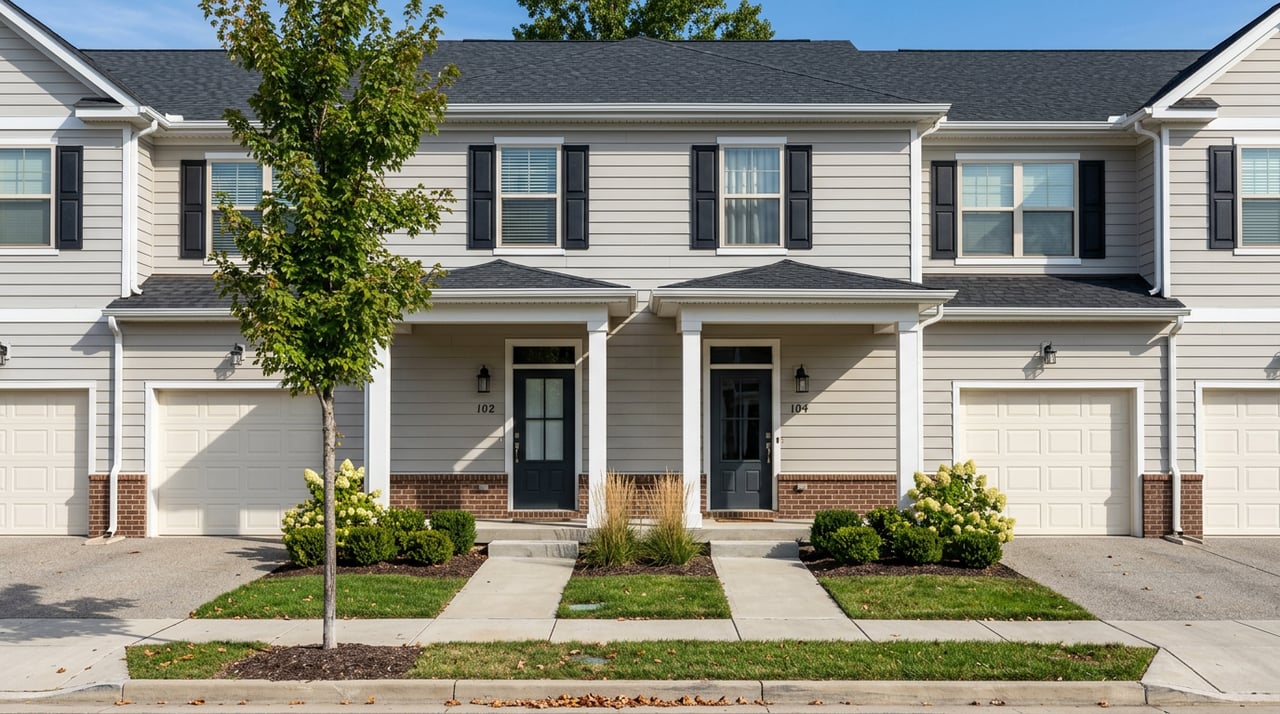
Hilliard Townhome vs Single Family: How to Decide
March 24, 2026
March 24, 2026
Is a low‑maintenance townhome the smarter move for your budget and lifestyle, or will a detached house in Hilliard give you the space and control you want? If you are weighing those options, you are not alone. Many Hilliard buyers compare entry price, HOA fees, taxes, and day‑to‑day upkeep before they choose. In this guide, you will learn how costs stack up, what to look for in HOA communities, and a simple worksheet to estimate your monthly “all‑in” budget. Let’s dive in.
Public market trackers place Hilliard home values in the mid‑$300,000s to low‑$400,000s as of early 2026. For example, one tracker reported a median sale price near $397,000 in February 2026, while another showed an average in the $372,000 to $379,000 range for the same period. Methods differ by provider and whether condos and townhomes are included, so you should expect some variation.
Townhomes and condo‑style units exist in Hilliard but are less common than single‑family homes. Because active townhome counts are small at times, a single high‑priced listing can skew the “median” for that segment. Treat any townhome median with caution and compare individual properties instead.
Inventory and days on market move with the season. Some newer communities near Quarry Trails include a mix of condos, townhomes, and single‑family homes at a range of price points. If you want pinpoint data for a specific month or neighborhood, ask for a live snapshot before you write an offer.
Many Hilliard townhomes are in HOA communities that handle exterior maintenance, common‑area care, lawn and snow, and often trash service. Local listings commonly show HOA dues around the mid‑$200s to high‑$300s per month, with examples near $313 and $347. The exact coverage varies by community, so verify line items in writing.
With single‑family homes, you typically manage all exterior maintenance and repairs yourself. You gain full control over materials, timing, and upgrades, but there is no HOA to pool costs. A practical planning rule is to set aside at least 1% of the home’s value per year for maintenance, with older homes often needing more. Recent analyses discuss a 1% to 4% range; use 1% as a conservative floor and adjust up for age and condition based on guidance like Bankrate’s maintenance cost overview.
Attached townhomes share walls, so you trade some privacy and quiet for convenience and lower exterior upkeep. Private outdoor space is usually limited to a small patio or modest yard, with shared landscaping maintained by the HOA. Detached homes generally provide greater separation, more yard, and often more storage or garage area. Your choice comes down to daily lifestyle and tolerance for shared elements.
If you choose an HOA‑governed townhome, review the financials and rules before you commit. Request the current budget and reserve study, recent board meeting minutes, rules on pets, parking, and rentals, the insurance master policy summary, and any notices about special assessments. The Foundation for Community Association Research notes that an association’s financial health and governance are major long‑term risk drivers. Their 2024 survey provides useful context on how owners experience HOA living and where friction points arise. You can learn more from the Foundation for Community Association Research’s 2024 survey.
“Townhouse” can describe two different legal forms, and lenders treat them differently. A fee‑simple attached townhouse means you own the land and structure, and lenders often underwrite it like a single‑family home. A unit that is legally a condominium means you own the interior, with the association owning common elements. Condo‑structured townhomes may require condominium project eligibility for certain loans. For a clear primer, see NerdWallet’s explanation of townhouses and condos.
If you plan to use FHA or VA financing, confirm whether the condominium project is approved. FHA allows project‑level and some single‑unit approvals, but you should verify status early in the process. Review the HUD guidance on FHA condominium approvals with your lender before you write an offer.
Insurance needs also shift with ownership type. Condo owners typically carry an HO‑6 policy that covers interior finishes and personal property, because the association’s master policy insures the exterior and common areas. Fee‑simple townhomes and detached homes usually require an HO‑3 or HO‑5 homeowners policy that covers the full structure plus personal property. Premiums and coverage differ, so request the association’s master policy and match your policy to the gaps. For a consumer overview of condo versus homeowners coverage, review Insurify’s guide to condo and homeowners insurance.
When you compare a townhome to a house, look past the list price and estimate your monthly “add‑ons” beyond principal and interest.
Here is a clear template using Hilliard‑specific assumptions:
Illustrative math for the example above:
Total monthly add‑ons (tax + HOA + maintenance + insurance) land around $1,330 to $1,413/month in this scenario. This does not include your mortgage principal and interest. Rates and premiums change quickly, so get lender and insurance quotes for your specific property.
How to use this:
You will likely see a wider selection of single‑family homes than townhomes at any given time in Hilliard. Entry‑level attached options sometimes come in below comparable detached homes, but monthly HOA dues can narrow that gap. On the other end, luxury and new‑construction townhomes with upgraded features can rival or exceed detached home prices.
If you value convenience, predictable exterior upkeep, and smaller private outdoor areas, a townhome can be a strong fit. If you prioritize privacy, yard space, and full control over improvements, a detached house is often the better match. Either way, your smartest move is to compare the total monthly cost and to inspect the HOA’s financial health if you are buying an attached unit.
Use this list to stay organized before you make an offer:
If you want help deciding between a Hilliard townhome and a detached home, let’s compare real listings and run the numbers side by side. I will bring current market data, HOA documents, and a clean cost model so you can choose with confidence. If you are also planning to sell, you can Request Your Free Home Valuation and map your buy‑sell timeline in one conversation. Connect with Deborah Parris to get started.

Your Next move starts with a conversation.
DEBBIE PARRIS
3160 Kingsdale Center Upper Arlington OH 43221